
Narrow-Barred Mackerel or Tanguigue (more commonly called Spanish Mackerel or just Spaniards) are the prime target in our waters with specimens to over 60 lb (27 kg) common.
 They will readily take jigged chrome slices, trolled or floated garfish and pilchard baits as well as trolled lures. Sportfishing tackle of at least 6 kg is preferred with the use of a heavy wire leader and black swivels essential for both lure and bait fishing. Their sharp, scissor like teeth will make short work of anything less and their eyesight is superb. Many a floating bait has been snipped off at the tail, irritatingly just behind any imbedded hooks which must be razor sharp.
 Once hooked Spaniards will make one long spirited run and usually tire shortly after, smaller shorter runs precede gaffing at the boat.
 Spaniards are excellent eating but must be killed by a sharp blow to the head and bled immediately upon capture. This will not only preserve the flesh but make them much easier/ safer to handle, most anglers will carry a heavy wooden "donger", similar to a small baseball bat, on board for this purpose.
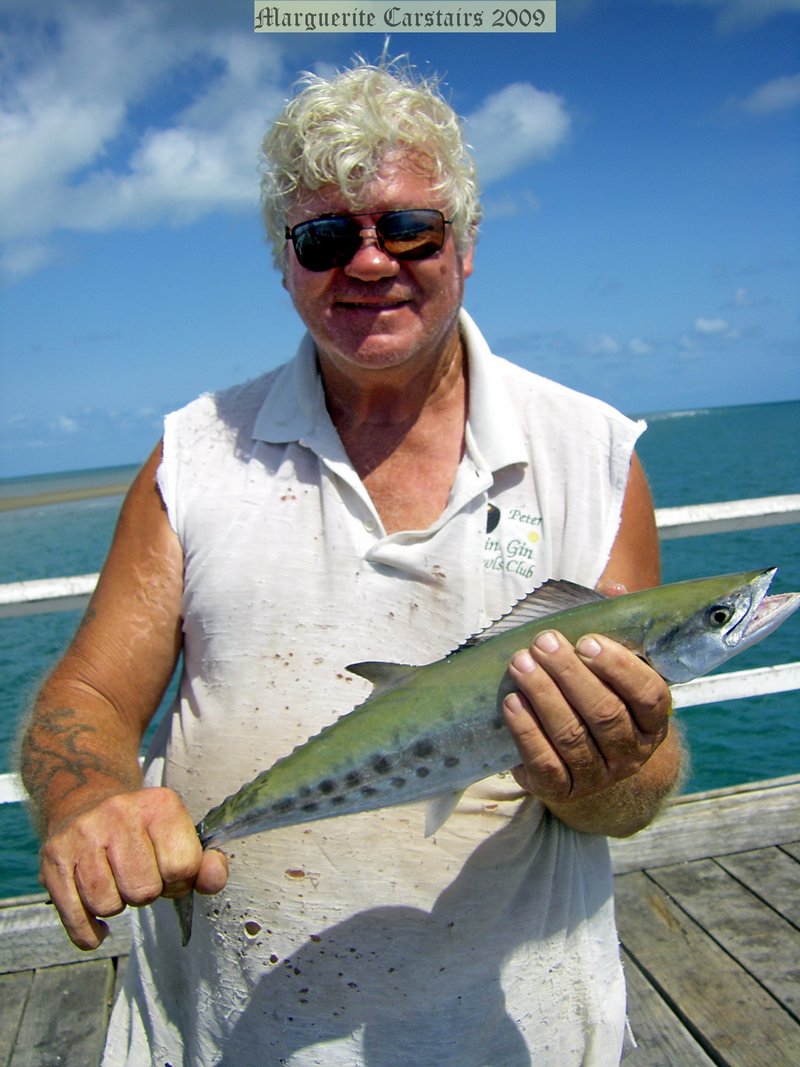
 Spotted Mackerel, or "doggies" as they are known locally, are similarly caught on our barrier reef . Drifting pilchard of garfish baits is the preferred method for these much smaller fish but captures on lures is also common.
The fish can either be cut up into steaks or filleted and skinned, either way the flesh is excellent eating. Size and bag limits do apply.


 a zebra, having alternating black and white stripes running vertically the length of its body. The reef butterfly starts with yellow at the top and fades to white on its belly. Most butterfly fish mate for life and raise their young together. Sometimes, if one dies, the other may also perish. Occasionally, there may be three to six in a small group. These little fish are a delight to visit on a coral reef. They are usually busy pecking away at the coral and scurry quickly if disturbed; however, if you move slowly, it is possible to follow them, film them successfully, or just enjoy them.
140x45.jpg)


 Posts
Posts

