Showing posts with label Hervey Bay. Show all posts

Monday, August 23, 2010

Gyrocopter flies at the Point at Hervey Bay

Gyrocopter at Hervey Bay


New artwork now graces a Hervey Bay site that Fraser Coast inhabitants have regarded as "one of the best places in the world" for thousands of years. The artwork includes a shelter, two seats and designs embedded into a decorative concrete pad.
The artwork was by local Butchulla people. Those involved included artists Shawn Wondunna-Foley, Jan Williams, Shirley Blake, Annette Broome, Shortea Broome, Deleece Henderson and the Scrub Hill community with Auntie Francis as the overseeing Elder.
http://www.arts.qld.gov.au/funding/dayman-park.html


The Point

Hervey Bay is a well-frequented holiday destination, a huge retirement centre, and the most popular access point to Fraser Island. Essentially a string of associated villages - Urangan, Torquay, Scarness, Pialba and Point Vernon - it stretches along the bay in a series of small shopping centres and a seemingly endless run of holiday units, motels, caravan parks and flats.

Located 300 km north of Brisbane and 37 km east of Maryborough, Hervey Bay's great attraction lies in the diversity it offers - whale spotting, fishing, walking, water skiing, scuba diving, fishing, exploring nearby Fraser Island. There is a bird sanctuary and an aquarium. There is also an interesting and substantial historical museum and a memorial to the kanakas who worked the sugar fields in the area.

Hervey Bay has had little respect for its past. Once a series of quiet and sleepy villages it is now in the process of exploding into a Gold Coast style series of holiday destinations. It is now a city (officially proclaimed in 1984) encompassing a series of small villages, all of which now blend together. With this development has come the inevitable problem that much of the character of the area has been sacrificed by the construction of modern project homes for people (apparently most of them came from Victoria) eager to retire to the sun. This problem is compounded by the fact that much of the beach foreshore is taken up with Caravan Parks (it actually boasts that it is the 'Caravan Capital of Australia') creating a very one dimensional feel about the place - shops on one side of the Esplanade, then Caravan Parks, then a narrow hard sand beach.

The first European to reach the Hervey Bay area was Captain James Cook who sailed past Fraser Island naming many of the prominent features. Cook did not sail into Hervey Bay. In fact he was some 6 km offshore as he sailed north. This did not stop him naming the bay after the 'English Casanova', Augustus John Hervey, a sailor of some note who acquired a fierce reputation as a womaniser.

Matthew Flinders passed through the area twice. In 1799, Flinders sailed around Fraser Island entering the bay and going ashore at the present site of Dayman Park. He was the first European to step ashore at Hervey Bay.

It is one of the ironies of history that Flinders, who returned to the area in 1802 on his historic circumnavigation of the Australia, did not located the Fraser Island Straits on either of his voyages.

The first settlement of Hervey Bay occurred in the 1850s. Hervey Bay was originally part of a cattle station, the Toogoom Run, which was settled in 1854. The first permanent white settler at Hervey Bay was Boyle Martin who, with his wife and child, arrived in 1863. He worked cutting timber and it is suggested that he was the first person to grow sugar cane in the area. By 1859 the first subdivision of land around Hervey Bay took place.

The attractions of the area were obvious. The fishing was good, the place was quiet, the weather was excellent, the area around the bay was flat and accessible. All these factors quickly led Maryborough businessmen to take up large waterfront blocks of land for weekend retreats.

In the 1870s many Scandanavian settlers moved into the area and for a short time Hervey Bay became known as Aarlborg. At this time the area was basically used for dairy farming.

In the 1880s sugar was introduced to the area and the Kanakas were brought from the South Pacific islands to work on the sugar plantations.

In 1896 the Bay was connected to Maryborough by railway and in 1917 (progress wasn't exactly rapid) the Urangan Pier was completed and Urangan became an important port for the export of sugar.

Modern tourism started in the 1950s when Hervey Bay became a popular retreat particularly for retired Victorians who were initially attracted to the area by the warmth of the climate and later the added appeal of 'no death duties'. It has continued to grow in popularity so that in 1984 Hervey Bay was proclaimed a city.

http://www.smh.com.au/news/Queensland/Hervey-Bay/2005/02/17/1108500203391.html

Thursday, August 12, 2010

Hervey Bay..the whales are back in Hervey Bay


Its whale time again in Hervey Bay.
Here the Humpback whale looks at the tourists on the boat.
This is also the weekend for the Seafood Festival at the Boat Club


Wednesday, January 27, 2010

Pialba Pier Hervey Bay


Pialba Pier is located right where there is a great Public Beach edged with tourist facilities and picnic areas.
It is the only beach access for wheelchairs.
However, the wheelchair access is closed because the lower section has been damaged.
It has been like this for 18 months..despite many attempts by the public to get this opened for the access of elderly walking to the beach, as well as wheelchairs. Seems strange that Council, who has many plans for attracting tourists, fail to attend to a simple matter like this. All it needs is a continuation of the track, which currently stops midair....we were able to jump down to the sand, butthis would not be easy for older less mobile people.

Its an interesting pier.

Whoever designed it did not really consider the use of a pier.
It looks attractive, and one can casually stroll to the end and back.
Next to the Pier was a boat hire place, now changed to a Restaurant which also hires some water craft.
The story goes that Council did not want the Boat hire there, and chose to have the Restaurant.
Maybe that is why they built the pier so boats could not tie to it, moor and have access to the pier.
You can see by the watermark where the water reaches the pier at High tide, and low tide there would be just sand.

There is no ladders or any other access to the pier from the water.

Young people jump off the pier to the water below...a dangerous feat when the water is shallow

The pier needs some mooring posts and ladders for boat access, and the wheelchair and elderly walkway fixed so it can be used, and the area would be wonderful.
Posted by Picasa

Monday, January 25, 2010

High Tide


High tide, originally uploaded by Ladymaggic.
I stayed on Moon River and this was the view at High tide.
The sandbanks are all under water and across is Burrum Heads
All you can see is water.


Wednesday, December 16, 2009

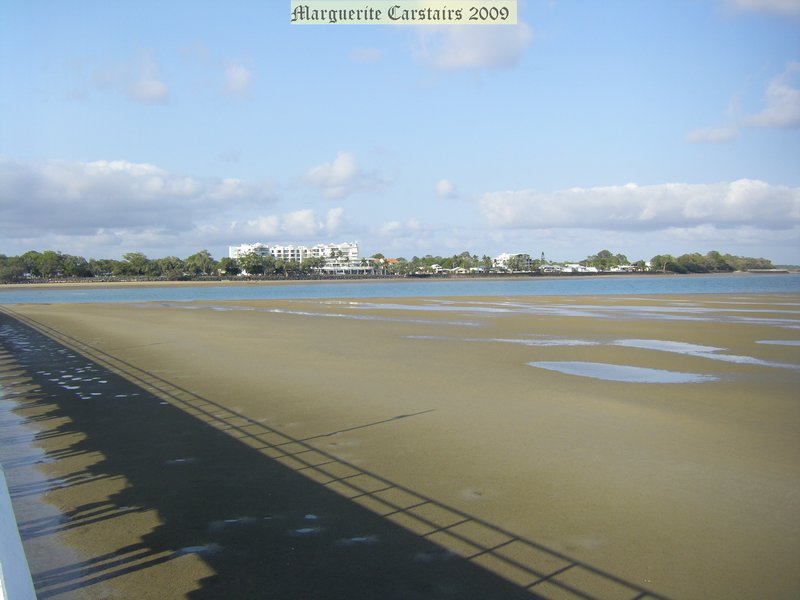
Shadows and Stingray Hollows


Shadows and Stingray Hollows, originally uploaded by Ladymaggic.
Stingrays make hollows in the sand.
You can see this quite clearly at Low tide.

I am standing on the pier at Urangun in Hervey Bay


Fishing Trawler returning full of fish

Maddison Returns to Hervey Bay

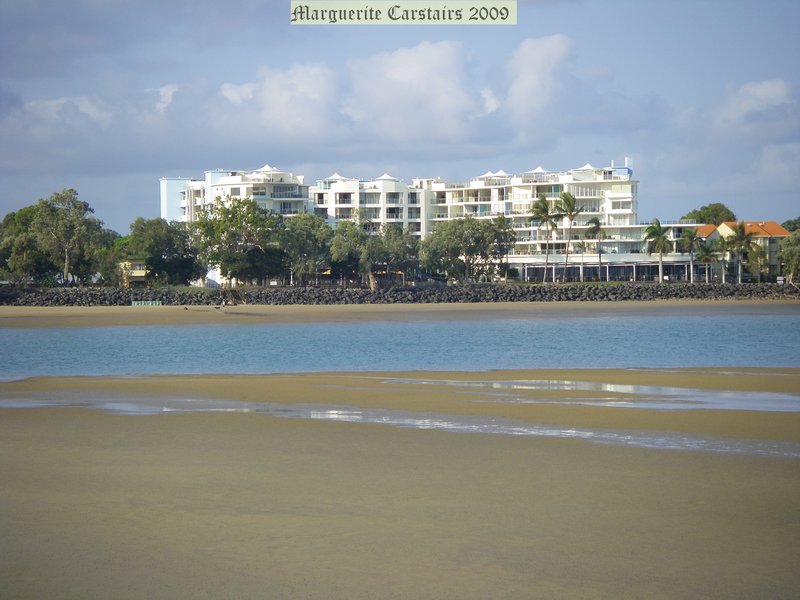
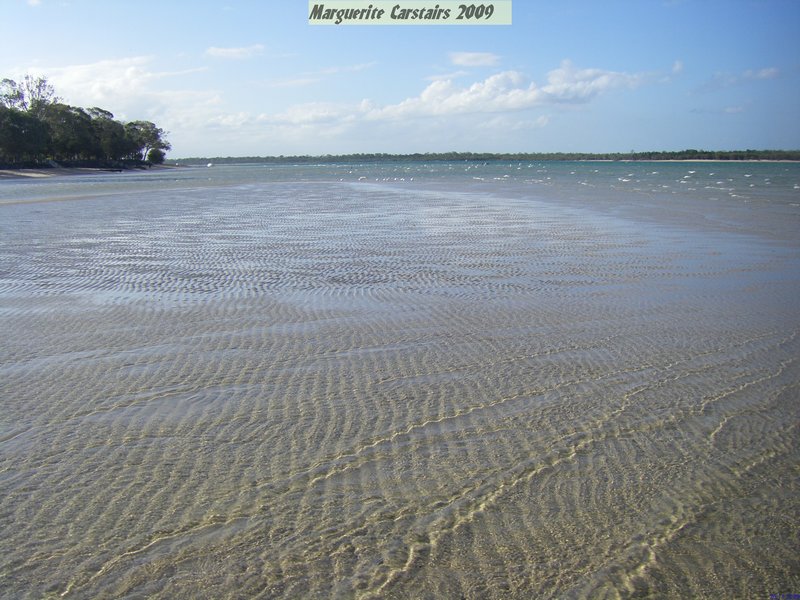
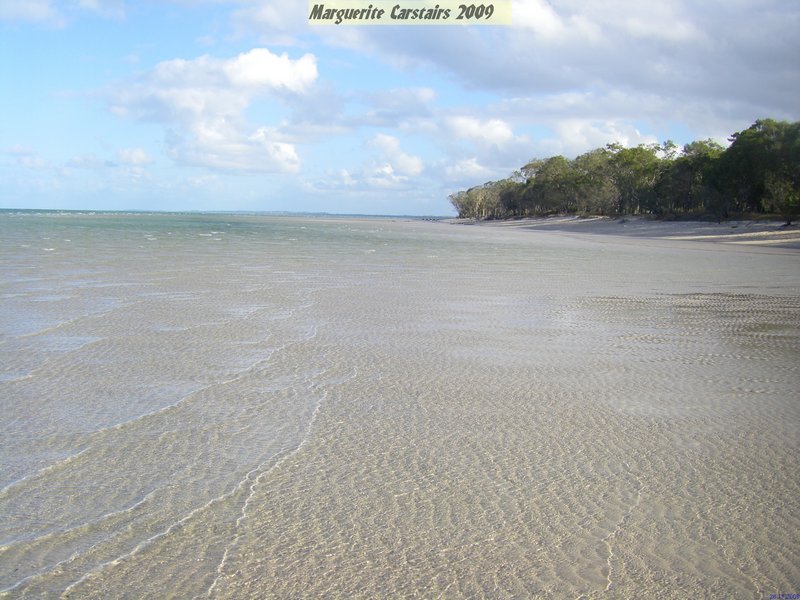
Low tide sand banks Hervey Bay


Low tide sand banks Hervey Bay, originally uploaded by Ladymaggic.
The colors of the sea were just beautiful...blue as blue.
The sand banks went out to sea a long way.
The colors of the sand and the sea were beautiful


Mackerel


Mackerel, originally uploaded by Ladymaggic.
Caught from the end of Urangun Pier at Hervey Bay
Narrow-Barred Mackerel or Tanguigue (more commonly called Spanish Mackerel or just Spaniards) are the prime target in our waters with specimens to over 60 lb (27 kg) common.
Spanish MackerelThey will readily take jigged chrome slices, trolled or floated garfish and pilchard baits as well as trolled lures. Sportfishing tackle of at least 6 kg is preferred with the use of a heavy wire leader and black swivels essential for both lure and bait fishing. Their sharp, scissor like teeth will make short work of anything less and their eyesight is superb. Many a floating bait has been snipped off at the tail, irritatingly just behind any imbedded hooks which must be razor sharp.
Once hooked Spaniards will make one long spirited run and usually tire shortly after, smaller shorter runs precede gaffing at the boat.
Spanish Mackerel Spaniards are excellent eating but must be killed by a sharp blow to the head and bled immediately upon capture. This will not only preserve the flesh but make them much easier/ safer to handle, most anglers will carry a heavy wooden "donger", similar to a small baseball bat, on board for this purpose.
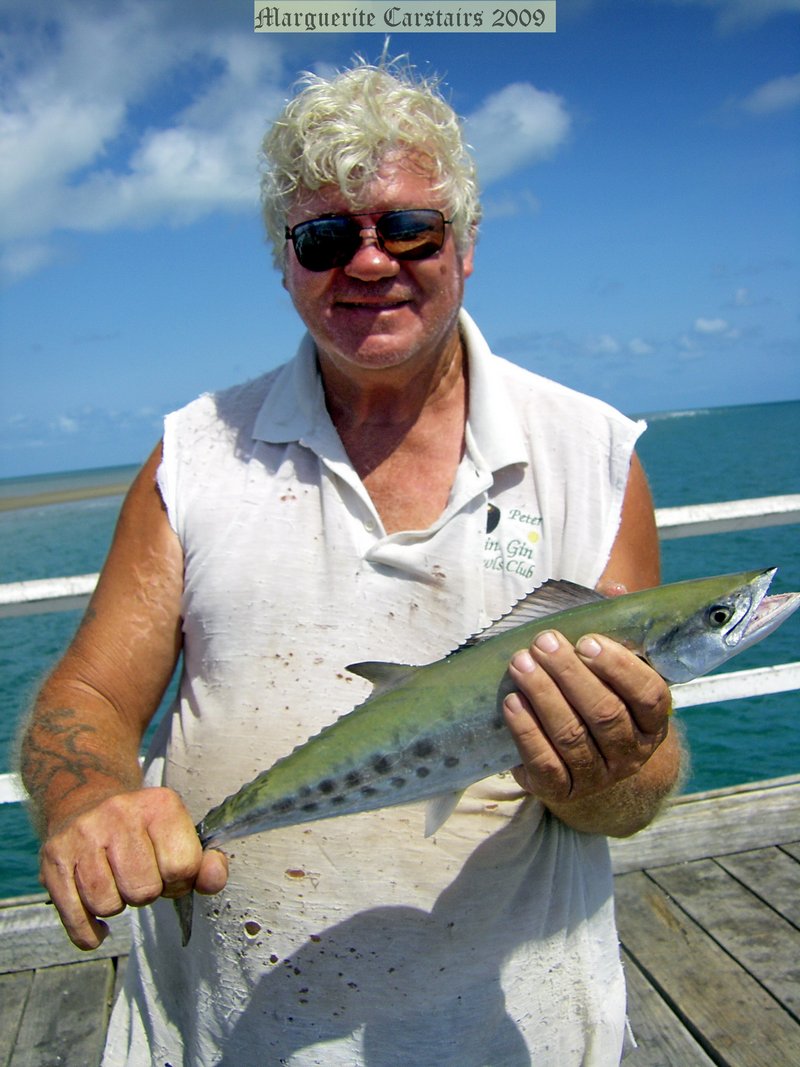
Spotted Mackerel, or "doggies" as they are known locally, are similarly caught on our barrier reef . Drifting pilchard of garfish baits is the preferred method for these much smaller fish but captures on lures is also common.
The fish can either be cut up into steaks or filleted and skinned, either way the flesh is excellent eating. Size and bag limits do apply.


Sunday, December 6, 2009

Urangun Pier Deep sea fishing


Urangun Pier, originally uploaded by Ladymaggic.
Urangan pier is 868 kms long, and the end is where the 'big fish' can be caught.

This is where the serious fishermen fish


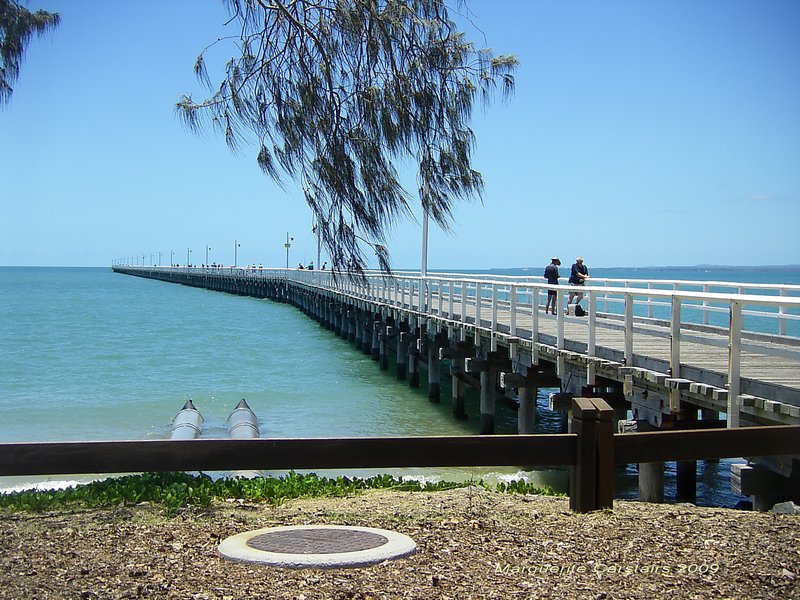
Urangun Pier Hervey Bay


Urangun Pier, originally uploaded by Ladymaggic.
Finally made it to the Urangun Pier.
Such a beautiful walk and the scenery on either side was so beautiful.
The waters are blue as blue and the sand was golden.

  Information Board for details


Wednesday, November 25, 2009

Tide is coming in at 5 pm...


Tide is coming in at 5 pm..., originally uploaded by Ladymaggic.
The tide came in at a very fast pace.
One moment I was walking on the edge of the water out in the bay, then I was almost at the edge of the shoreline as the tide followed me.

You could see the water coming in in swirling waves.
It was very beautiful


Tuesday, October 13, 2009

Beachwalk in the morning


Beachwalk in the morning, originally uploaded by Ladymaggic.
There is a leash free beach at Pialba where the dogs can run free and play in the water.
Every other day, I walk the dogs to the beach.
Stone likes to chase a stick in and out of the water. Brownie chases the birds trying to catch them.
One morning he went swimming after a seagull, and I watched horrified wondering whether he would come back or swim off forever. He did turn back eventually.
The water is wonderful for the dogs, and also children as its veru safe and smooth at Low tide.
Gef and Mark, and their dog Missie, came walking with us this fine morning


Arriving at Hervey Bay


Gef Also Wears Prada

Sunday, September 27, 2009

Soldier Crabs


SoldierCrab Droppings, originally uploaded by Ladymaggic.
Hervey Bay is full of Soldier Crabs

This entire exposed island at low tide is all soldier crab droppings.

This video of the soldier crabs at Hervey Bay is fantastic...
http://www.youtube.com/watch?v=cWM8K4YShc0


Shoreline at the Beach


Shore, originally uploaded by Ladymaggic.
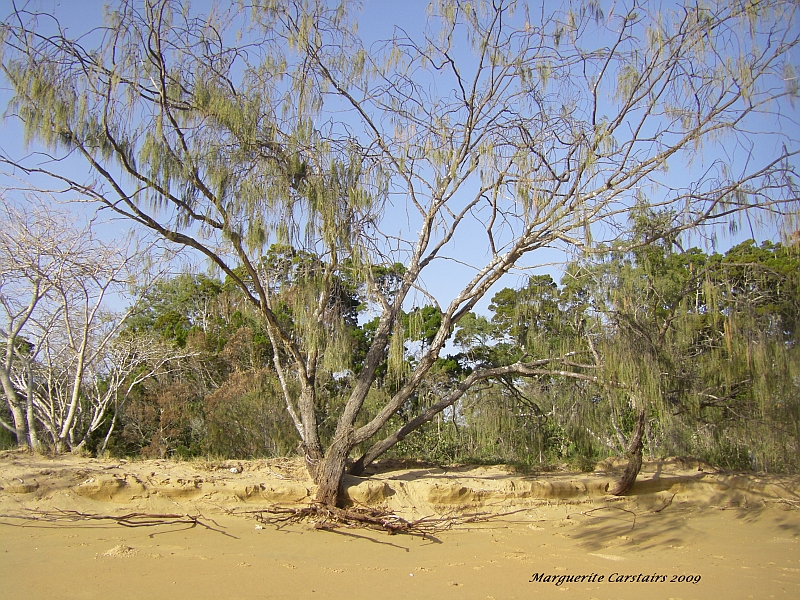
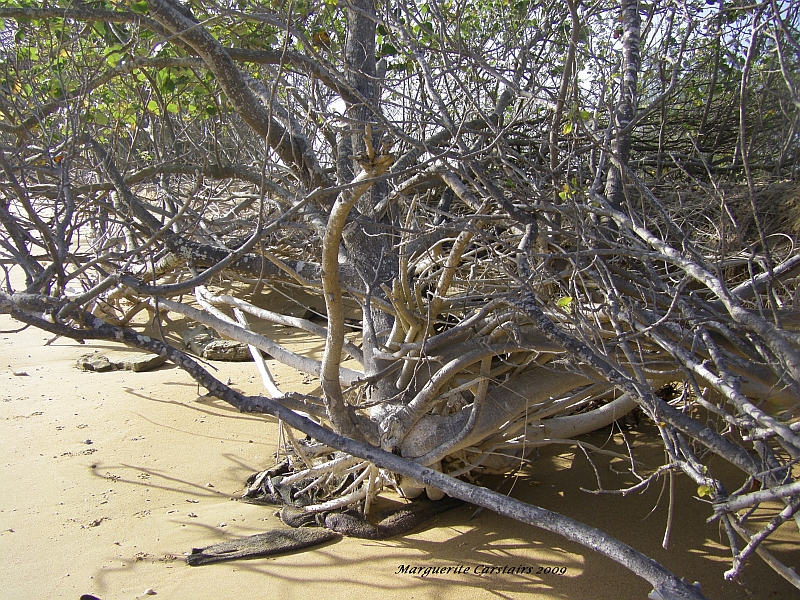
The tide comes in right up to the edge, and you can see where erosion is taking place.
The shore is now edged with trees that have fallen, and there are many roots visible as the sand gets washed away.
There are plans for rehabilitating the beach, and they do need to start soon, as already the line of bach has enroached into the line of land.

There is a caravan park right on the beach, and I have plans to stay there when i need somewhere to stay. It looks awesome.
Right now its the school holidays and there are tents almost on the beach. Its a beautiful location for a Caravan Park.


Thursday, September 10, 2009

Whale Watching Hervey Bay

Under Tail


Young Humpoback whales at Hervey Bay in August 2009 They are very curious about people as you can see..The whale loved the Tourist Boat and the people cheering. The day was beautiful.

 Hervey Bay whale watching in Queensland, Australia is now known internationally as the whale watching capital of the world. In 1987 several local fishing boat operators noticed that the recovering humpback whale population, in the area, was staying in the Bay for several days and they were becoming inquisitive about the boats in the area. Some started to add whale watching trips to there itineraries and the fledgling industry then took off with a bang. Within two years there were twenty boats operating daily services during the season which lasts from mid July through to early November. Today the population of whales continues to recover strongly and there are many more whales to see. Because of the high level of continuing interest in whale watching in the area the area has been declared a marine park and the operators have became licensed under a permit system which is designed to protect both the whales and the industry that has been generated.


The whales that visit Hervey Bay are predominately Humpback Whales which enter the area as part of there annual northern migration. There area is now known to be important as part of the whales breeding cycle and it is common to see mating activities, new born calves and mothers suckling their young. The song of the humpback whales is also commonly heard in the bay and most of the boats carry hydrophones so that the many whale watchers can enjoy this phenomenon. Two of the current boats in the fleet also have underwater windows, while many others have underwater video cameras which can show their submarine activities via an on board video monitor.


whale goes to look at small boat


Sugar Cane Burning


Burning

Cane Fires

Sugar Cane grows at Hervey Bay, and Maryborough has a huge Sugar Refinery.
Now the cane is ready and it is burnt.
I was driving when I saw the smoke and smelt the sugary scent of the burning cane.
The Fire Resue was in attendance and so were many people with cameras watching the cane burn.
This morning a truck was taking away the cane in a swirl of dust.

The first settlement of Hervey Bay occurred in the 1850s. Hervey Bay was originally part of a cattle station, the Toogoom Run, which was settled in 1854. The first permanent white settler at Hervey Bay was Boyle Martin who, with his wife and child, arrived in 1863. He worked cutting timber and it is suggested that he was the first person to grow sugar cane in the area. By 1859 the first subdivision of land around Hervey Bay took place.
By the 1920’s the area had established strong growth in its primary industries of sugar cane, citrus fruits, beef and fishing.

Sugarcane, or sugar cane, is any of six to thirty-seven species  of tall perennial grasses of the genus, Saccharum, (family Poaceae, tribe Andropogoneae). Native to warm temperate to tropical regions of Asia, they have stout, jointed, fibrous stalks that are rich in sugar and measure two to six meters (six to nineteen feet) tall. All sugar cane species interbreed, and the major commercial cultivars are complex hybrids.
Burning cane in preparation for harvest continues to be an integral and essential part of farming operations for the majority of cane growers.
Under the Queensland Fire and Rescue Service Act 1990, special provisions apply to the burning of sugarcane, tops and trash in those situations where a grower's Cane Production Area (CPA) is bordered on every side by other cane land.

Fire Fighter

Watching the Fire

In Consultation


Boat Club at Hervey Bay

View from the Boat Club

Seagull View

Yachts at Hervey Bay Boat Club

The Boat Club is situated at Urungan right at the end of the Coast.
From this point the ferries and Tour boats leave for whale watching and to Fraser Island.
You can sit on the open verandah of The Boat Club and watch the tour boats leave in the morning and return at midday and in the evening.
The boat Club has a fantastic restaurant and Bistro Bar with daily Music and entertainment, and you can relax and listen to the Music or dance on the popular dance floor.

The Hervey Bay Boat Club provides a complete entertainment venue with a la carte dining, coffee shop, bars, free live entertainment, 180 of the latest poker machines, TAB and Keno, wedding reception and function facilities plus a limited hours child care centre and courtesy bus.

Visitors are always welcome at The Boat Club, Down By The Marina
http://www.boatclub.com.au/
 
 
Whalesong

Boat Harbour Hervey Bay

Networked Blogs

Followers