
Showing posts with label Beach. Show all posts
Showing posts with label Beach. Show all posts
Thursday, May 20, 2010


Wednesday, November 25, 2009
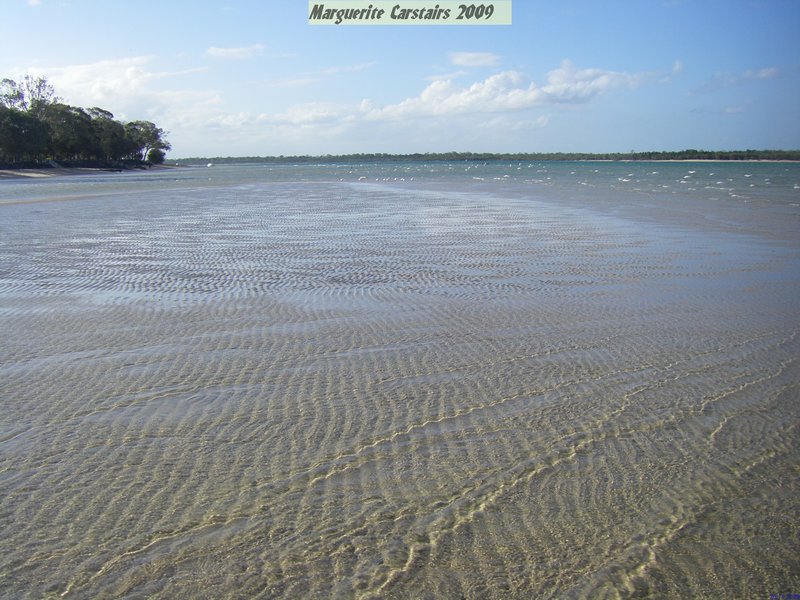
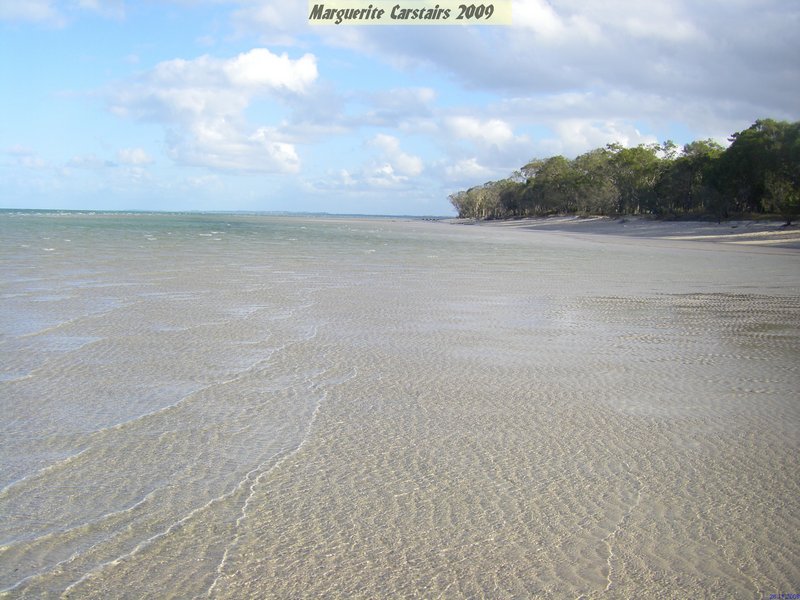
Tide is coming in at 5 pm...
The tide came in at a very fast pace.
One moment I was walking on the edge of the water out in the bay, then I was almost at the edge of the shoreline as the tide followed me.
You could see the water coming in in swirling waves.
It was very beautiful


One moment I was walking on the edge of the water out in the bay, then I was almost at the edge of the shoreline as the tide followed me.
You could see the water coming in in swirling waves.
It was very beautiful
Monday, October 19, 2009
Bondi Beach Sydney Australia
Bondi Beach Sydney Australia
Home to the one of the world’s oldest surf life saving clubs, if not the oldest, this beautiful beach is the closest to the Sydney city centre (8kms). With the bright sunny days we get in Sydney Australia, even winter days are enjoyable here.
1km long, this south facing beach can attract more than 40,000 visitors on a typical summer weekend.
Offering topless sunbaking, swimming and great surfing for boards and bodies, the beach is popular with Australians as well as international tourists.
http://www.bondivillage.com/thennow.htm#history
Bondi" or "Boondi" is an aboriginal word meaning "water breaking over rocks" or "noise of water breaking over rocks." The Australian Museum records that Bondi means "place where a flight of nullas took place."
Between 1855 and 1877 Francis O'Brien of the Bondi Estate made the beach and the surrounding land available to the public as a picnic ground and pleasure resort, but for many years threatened to stop public access to the beach. In 1859 the Municipal Council asked the Government to establish an area at the beach as a public reserve but without success. It was not until June 1882 that the Government acted and Bondi Beach opened to the public.
In the mid 1850s buses begun to run to the edges of the Eastern Suburbs of Sydney. Transport beyond there was either on foot, horse or cart. Within a few years a number of private bus operators such as Old Steve, Joe Smith and M. Macnamara provided transport up to Bondi Junction. Generally speaking the buses ran about every half hour.
In 1933 the State Government took over the running of bus services to Bondi Junction. A year later Bondi Beach had a regular bus service with the main stop at Lamrock Avenue.
In the early 1870s the New South Wales Parliament introduced the Tramway Bill and by 1902 there was a sub-station at Bondi Junction. The electric tram service between Bondi Junction and the city of Sydney was established in 1905.
The first tram service to Bondi Beach was completed in 1929, and only after locals strongly protested to the authorities about the delay in extending the line from Bondi Junction. The last Bondi tram ran in 1958, and the huge Sydney tram network finally closed in February 1961. Whilst the Sydney trams were mainly burned, Melbourne is still one of the great tram cities of the world, and they are even extending their network.
 |
| From Sydney Manly 2008 |
Tuesday, October 13, 2009
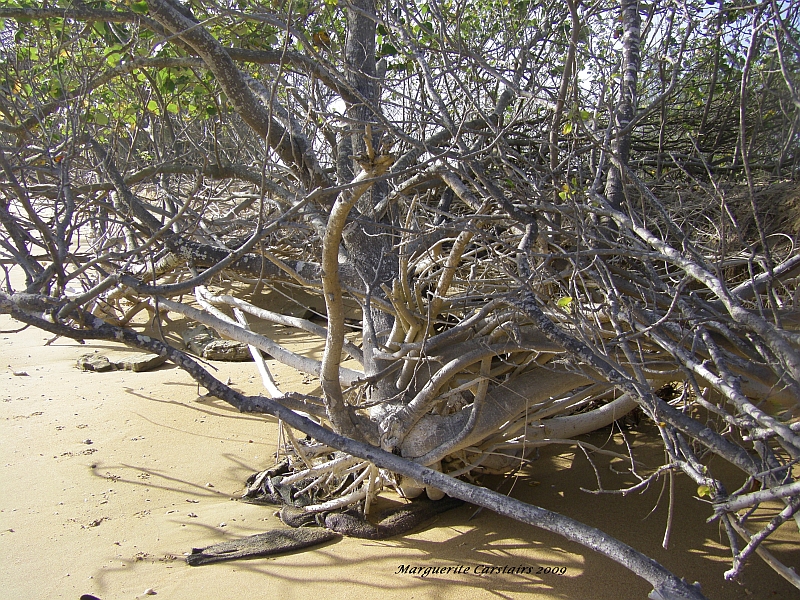
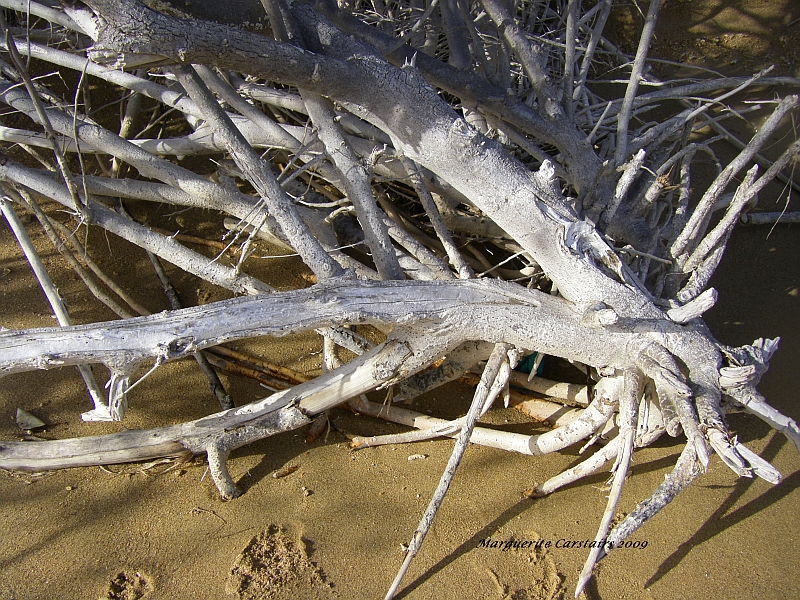
Erosion..Tree and Roots and effect of the Wind and Tides
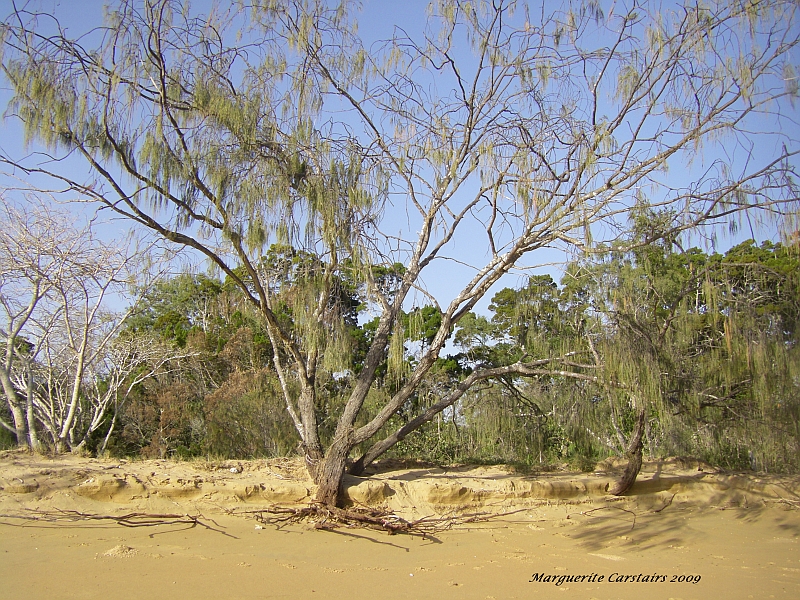
The tides and the winds are wearing away the Beach.
There has been talk of a Reclamation Project to protect the coastline that is slowly wearing down with time and weather.
Here the root system of the tree is entirely exposed.
Soon it will fall down and become another victim to the erosion like the others lining the shores.
http://www.epa.qld.gov.au/register/p01670aa.pdf
Sea erosion is a natural phenomenon of beaches. Beaches respond to environmental factors such as annual variations in the amount of sand washed down from rivers, changes in the geometry of river delta channels, and changes in the weather, especially prevailing winds, severe storms and tropical cyclones. The “active beach system” extends from well back in the dune system to seaward of the intertidal zone. As environmental conditions change, the beach profile changes as sand is moved onshore or offshore seeking an equilibrium profile. The movement of sand may appear as beach erosion, dune build-up or the formation of nearshore sand bars. These changes are commonly temporary, as the beach never achieves a stable profile, due to ever-changing environmental conditions. However, in some cases there may be a trend of ongoing erosion, resulting in long-term shoreline recession
Sea erosion can be classified as either long-term or short-term, depending on the time scale over which it occurs. Long-term erosion usually refers to a trend of erosion extending over several years and can be caused by a deficit in the annual sediment budget or in the longshore transport rates along the beach. Such erosion can occur without any reduction in the value of the beach natural system or as a public asset, as the beach profile is not changed but merely shifted landwards.
Short-term erosion refers to erosion that occurs over a period of days, rather than years, as a result of extreme weather events such as severe storm or cyclone activity. Short-term erosion results in changes to the profile of the beach. During short-term erosion events, the main sand transport mechanisms occur offshore. After the storm passes, normal beach processes usually produce onshore sand transport that restores the beach naturally. This natural restoration process may take many months or years. In most cases, intervention to restore the beach to its former condition is not required.
![]()

There has been talk of a Reclamation Project to protect the coastline that is slowly wearing down with time and weather.
Here the root system of the tree is entirely exposed.
Soon it will fall down and become another victim to the erosion like the others lining the shores.
http://www.epa.qld.gov.au/register/p01670aa.pdf
Sea erosion is a natural phenomenon of beaches. Beaches respond to environmental factors such as annual variations in the amount of sand washed down from rivers, changes in the geometry of river delta channels, and changes in the weather, especially prevailing winds, severe storms and tropical cyclones. The “active beach system” extends from well back in the dune system to seaward of the intertidal zone. As environmental conditions change, the beach profile changes as sand is moved onshore or offshore seeking an equilibrium profile. The movement of sand may appear as beach erosion, dune build-up or the formation of nearshore sand bars. These changes are commonly temporary, as the beach never achieves a stable profile, due to ever-changing environmental conditions. However, in some cases there may be a trend of ongoing erosion, resulting in long-term shoreline recession
Sea erosion can be classified as either long-term or short-term, depending on the time scale over which it occurs. Long-term erosion usually refers to a trend of erosion extending over several years and can be caused by a deficit in the annual sediment budget or in the longshore transport rates along the beach. Such erosion can occur without any reduction in the value of the beach natural system or as a public asset, as the beach profile is not changed but merely shifted landwards.
Short-term erosion refers to erosion that occurs over a period of days, rather than years, as a result of extreme weather events such as severe storm or cyclone activity. Short-term erosion results in changes to the profile of the beach. During short-term erosion events, the main sand transport mechanisms occur offshore. After the storm passes, normal beach processes usually produce onshore sand transport that restores the beach naturally. This natural restoration process may take many months or years. In most cases, intervention to restore the beach to its former condition is not required.

Sunday, September 27, 2009
Shoreline at the Beach
The tide comes in right up to the edge, and you can see where erosion is taking place.
The shore is now edged with trees that have fallen, and there are many roots visible as the sand gets washed away.
There are plans for rehabilitating the beach, and they do need to start soon, as already the line of bach has enroached into the line of land.
There is a caravan park right on the beach, and I have plans to stay there when i need somewhere to stay. It looks awesome.
Right now its the school holidays and there are tents almost on the beach. Its a beautiful location for a Caravan Park.


The shore is now edged with trees that have fallen, and there are many roots visible as the sand gets washed away.
There are plans for rehabilitating the beach, and they do need to start soon, as already the line of bach has enroached into the line of land.
There is a caravan park right on the beach, and I have plans to stay there when i need somewhere to stay. It looks awesome.
Right now its the school holidays and there are tents almost on the beach. Its a beautiful location for a Caravan Park.
Friday, September 4, 2009
Buildings on the Gold Coast

Buildings on the Gold Coast


High rise buildings dominate the Coast with windows opening to the Open Sea and Sky.
The views from Q1, the tallest building show this very clearly. The Gold Coast is High Rises with stunning views of the Sea.
It was interesting seeing a couple of small cottages along the coast, one next to the High Rises.
I called this cottage a Million dollar shack, which it has to be as the land would be worth a Highrise with a sea view. I yearned to knock on the door and see if my fisherman lived there, or someone who slept in and missed the morning.
Seldom was there anyone looking out of the windows or the balconies. The apartments were virtually deserted. Only once when I was trying to get a photo of the phone number above what looked like a backpackers place, two hungover guys glared at me, and I turned away feeling embarrased to be focusing on semi dereliction, when there was so much grandeur and beauty around.
I stayed the first week at The Shore, which was located right on the beach and gave me some fantastic sunrises. The second week I stayed at the Hawaain which was more upmarket, with downmarket views, and far too much shade, on level five when I always want High Living for the Views.
To my surprise both apartments lacked Internet facilities.
Gold Coast Flowers on the Beach


Gold Coast Flowers
The shore has been planted with many new plants.
Among them the strange twisting limbs of the cordylline create stark shadows and shapes against the sand.
Also prevalent were the red and gold Bottle brushes, which the parrots delighted in.
The flowers were vivid and rich and laden with nectar.
Fences were thick with this orange creeper full of rich vivid orange. Some of the creepers climbed and covered huge trees with a mass of orange blooms.
There was salt bush and pigface planted along the sands.
The Flowers attracted birds seeking nectar..the small Honey eater, the thrush and the colorful parrots.
Birds of Surfers Paradise Beach


Birds on the Shore and Water


The seagulls walked along the edge of the foam seeking small fish and digging the sand for sand worms and shellfish.
The trees along the shore attracted honey eaters and the colorful parrots.
As you walked along the edge where the plants grew, the air was full of bird song.
The birds were quite tame and happy to coninue their business watched by my curious camera.
There were ibis everywhere. They were at the parking area of the Apartment, at the Gas Station where small gardens edged the corners, and walking the enclosed shorelines like patrolling Officers with a folder under their wing.
The birds were always busy, making mockery of indolent and unaware humans strolling past unemployed and apparently aimless. The birds were not on vacation at all. They were constantly and steadily hard at work all the time.
Beach at Surfers Paradise Gold Coast Australia


Beach at Surfers Paradise
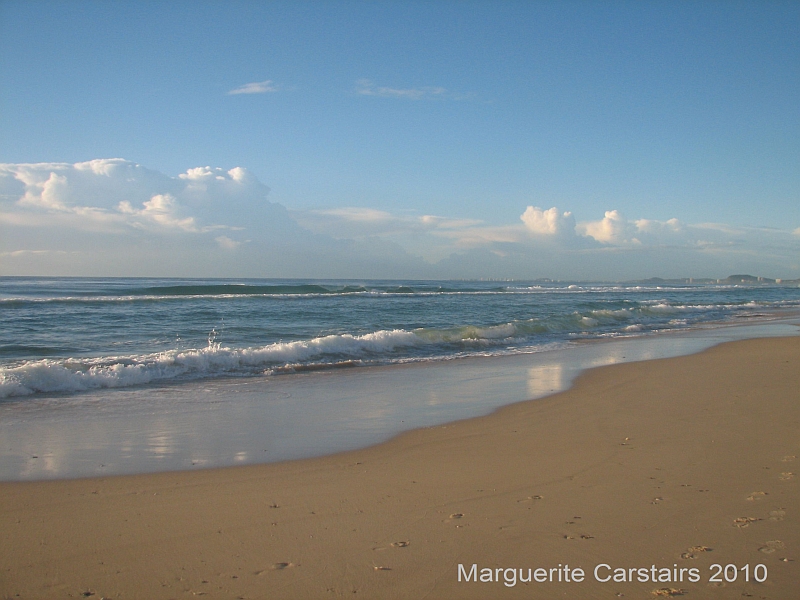
Every Morning I walked or ran on the beach.
Every morning was different. Sometimes the sunset was pink, other times bright red.
Sometimes there was no sunset, and one morning it drizzled rain and sprinkled my face with sharp drops.
Every morning the sand was scattered with footprints of running shoes, as joggers ran along the waters edge.
One morning there was a fisherman on the beach.
Another morning there were birds pecking at fish tails possibly thrown overboard by an unseen boat.
Mostly the mornings had only a few people, and only they saw the beauty of the early sunrise, and the rising of the sun.
Many people smiled or said hello as they walked or ran past.
The morning was very beautiful... almost alone, with nature waking up and throwing off the coverlets of the night, as she stretched forward her fingers of welcome to the Day she brought to the World
"Good morning", I say again as I jog past another runner, 'Good Morning to You"
And I smiled.
Surfers Paradise Gold Coast ...In the Morning


Buildings on the Gold Coast
High rise buildings dominate the Coast with windows opening to the Open Sea and Sky.
I walked every morning along the sea to the left of the apartment, and then the right. Every morning it was different and every morning was another beautiful day.
This is the early morning on the beach at Surfers Paradise
Subscribe to:
Posts (Atom)
About Me
140x45.jpg)
Networked Blogs

Subscribe To Coastal Art


 Posts
All Comments
Posts
All Comments