Showing posts with label pelicans. Show all posts

Saturday, December 26, 2009

Taking off


Taking off, originally uploaded by Ladymaggic.
They were standing on the waters edge.
I took some photos, then they took off just as I clicked this shot.

I thought I was very lucky to see their beautiful and strong wings at the point of take off.


Wednesday, November 25, 2009

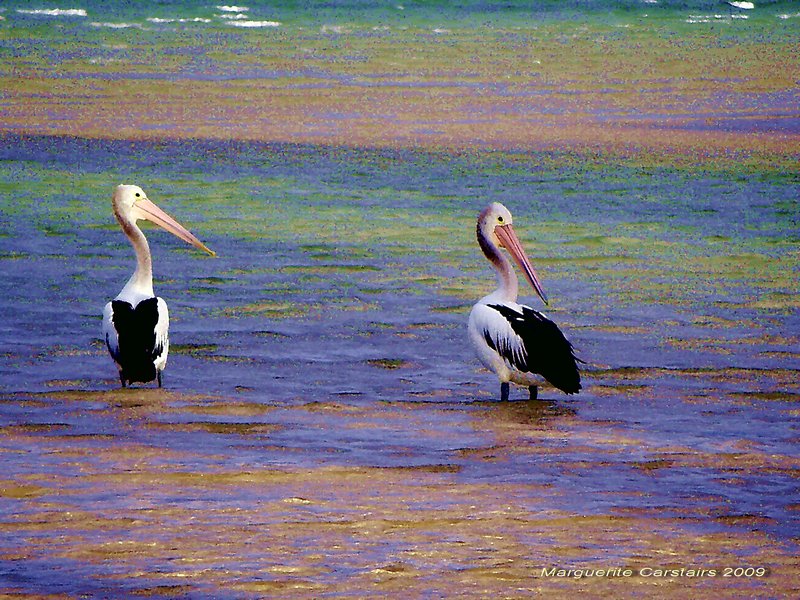
Pelicans on the Beach


Pelicans, originally uploaded by Ladymaggic.
Pelicans know when there are fish in the water.
They wait at places where the fish are.


Tuesday, November 17, 2009

Pelicans


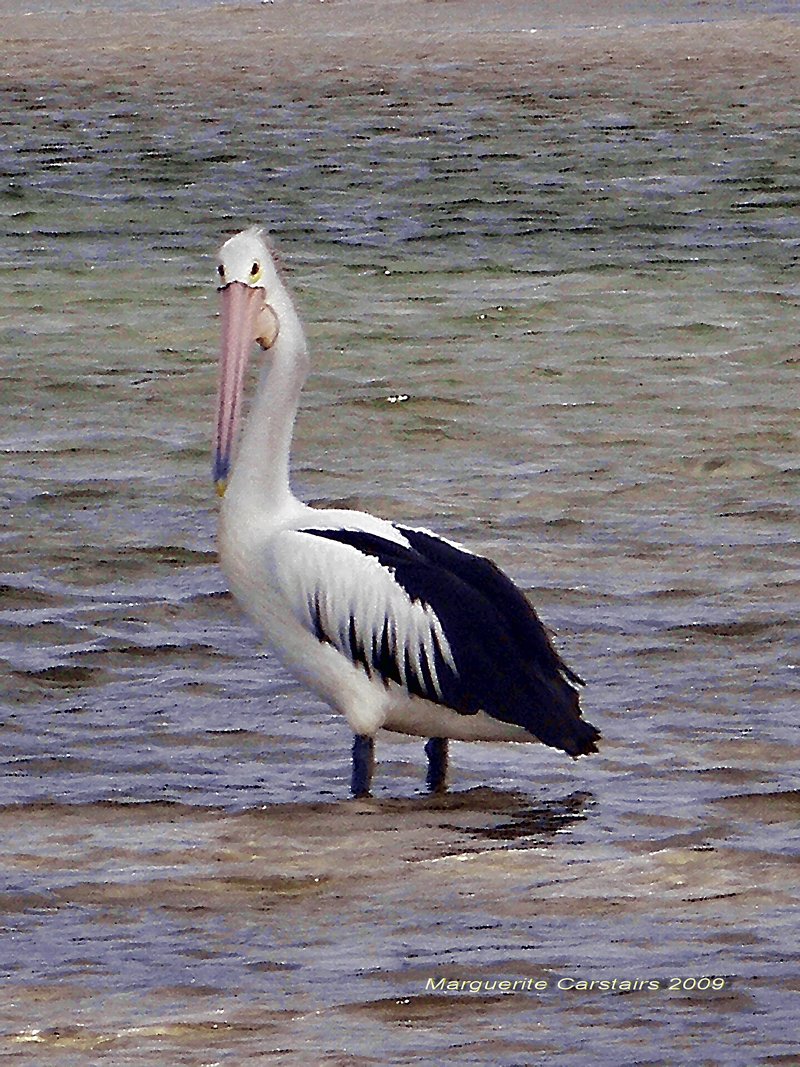
Australian Pelicans are huge black and white birds that live in areas with water all over Australia. They have very long pale pink beaks that have a small hook on the end and a stretching pouch underneath.
Rights:
© Australian Museum
Common name:
Australian Pelican
Scientific name:
Pelecanus conspicillatus

Additional information

Australian Pelicans are huge black and white birds that live in areas with water all over Australia. They have very long pale pink beaks that have a small hook on the end and a stretching pouch underneath. When their wings are outstretched they measure over 2 m across. They have feet with four fully webbed toes.
Australian Pelicans swim around searching for fish, yabbies and crabs to eat during the day. They sometimes swim in a group and drive fish into shallow areas. They trap the fish in their pouched beak and swallow them whole.
Australian Pelicans call with pig-like grunting sounds.
Australian Pelicans make loose nests on the ground from sticks and plant stems. Females lay two to four large white eggs. Both parents take turns to sit on the eggs (incubate) for 32 to 35 days. When the eggs hatch the chicks are helpless and without feathers. Both parents feed the chicks until they have feathers and are ready to fly in about 14 weeks.
Although spending a lot of time on the water, pelicans never dive.

Tuesday, October 13, 2009

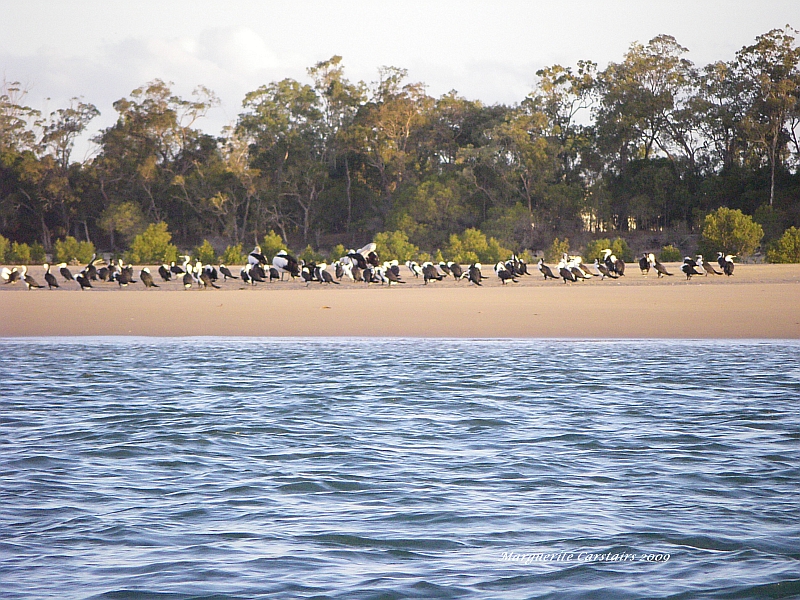
Comorants and the Mangroves of Burrum Heads


Low Tide on the River, originally uploaded by Ladymaggic.
Comorants live in the Mangroves along the River
So do Pelicans and other birds.
Burrum Heads is a Protected Water Sanctuary for Birds and the Mangroves


Mangroves are trees and shrubs that grow in saline coastal habitats in the tropics and subtropics – mainly between latitudes 25° N and 25° S. The saline conditions tolerated by various species range from brackish water, through pure seawater (30 to 40 ppt), to water of over twice the salinity of ocean seawater, where the salt has become concentrated by evaporation (up to 90 ppt).[1][2]

The many species of trees and shrubs adapted to saline conditions are not all closely related, and the term "mangrove" may be used for all of them, or more narrowly only for the mangrove family of plants, the Rhizophoraceae, or even more specifically just for mangrove trees of the genus Rhizophora

Mangroves form a characteristic saline woodland or shrubland habitat, called mangrove swamp, mangrove forest, mangrove or mangal.[3] Mangals are found in depositional coastal environments where fine sediments (often with high organic content) collect in areas protected from high energy wave action. They occur both in estuaries and along open coastlines. Mangroves dominate three quarters of tropical coastlines

Networked Blogs

Followers